
Fourteen years ago this week, a plutonium-powered robot the size of a small SUV thumped down inside a Martian crater and started driving up a mountain. It’s still going. This week it sent home a picture that reportedly stopped its own science team cold: an entire valley floor patterned like the inside of a beehive, stretching in every direction as far as the cameras could see.
💛 Benefits: Planetary scientists and curious minds everywhere
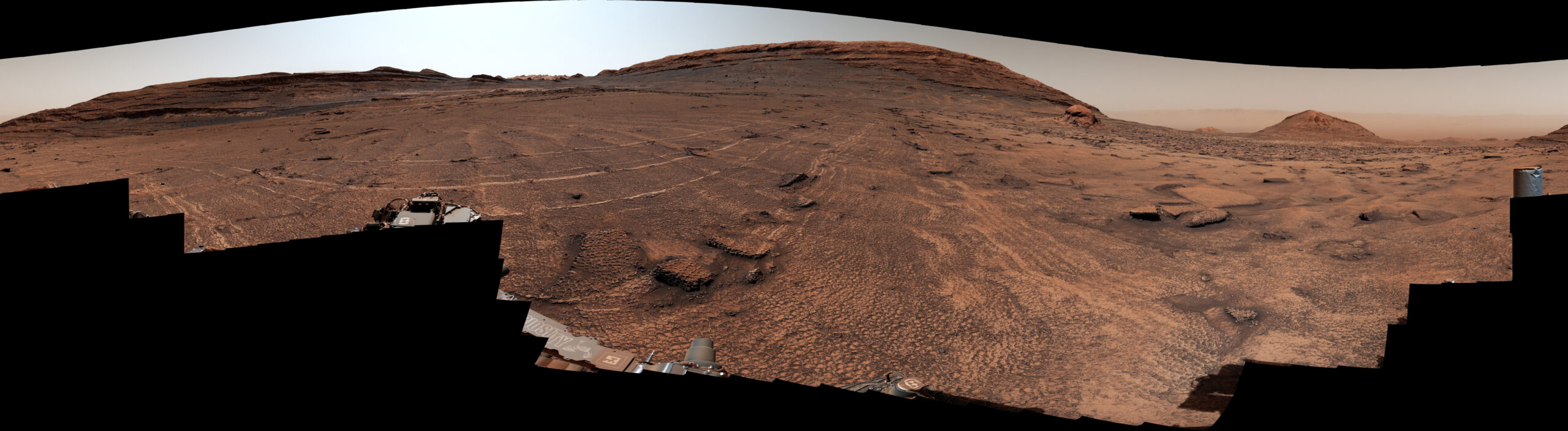
NASA’s Curiosity rover’s 360-degree panorama of the honeycomb-patterned valley “Valle Grande,” stitched from 340 individual photos. Credit: NASA/JPL-Caltech/MSSS
A Valley Wallpapered in Honeycomb
While climbing a stretch of terrain nicknamed “Valle Grande,” Curiosity stitched together 340 individual photos into one sweeping 360-degree panorama. What came back wasn’t rock and dust scattered the usual Martian way. It was pattern: thousands of tight, six-sided cracks, each just 1.5 to 3 inches across, tiling the ground like floor tile nobody ever grouted. The polygons even climb the sides of a nearby 20-foot mound the team calls “Miraflores,” capped with wind-blown sand like frosting nobody asked for.
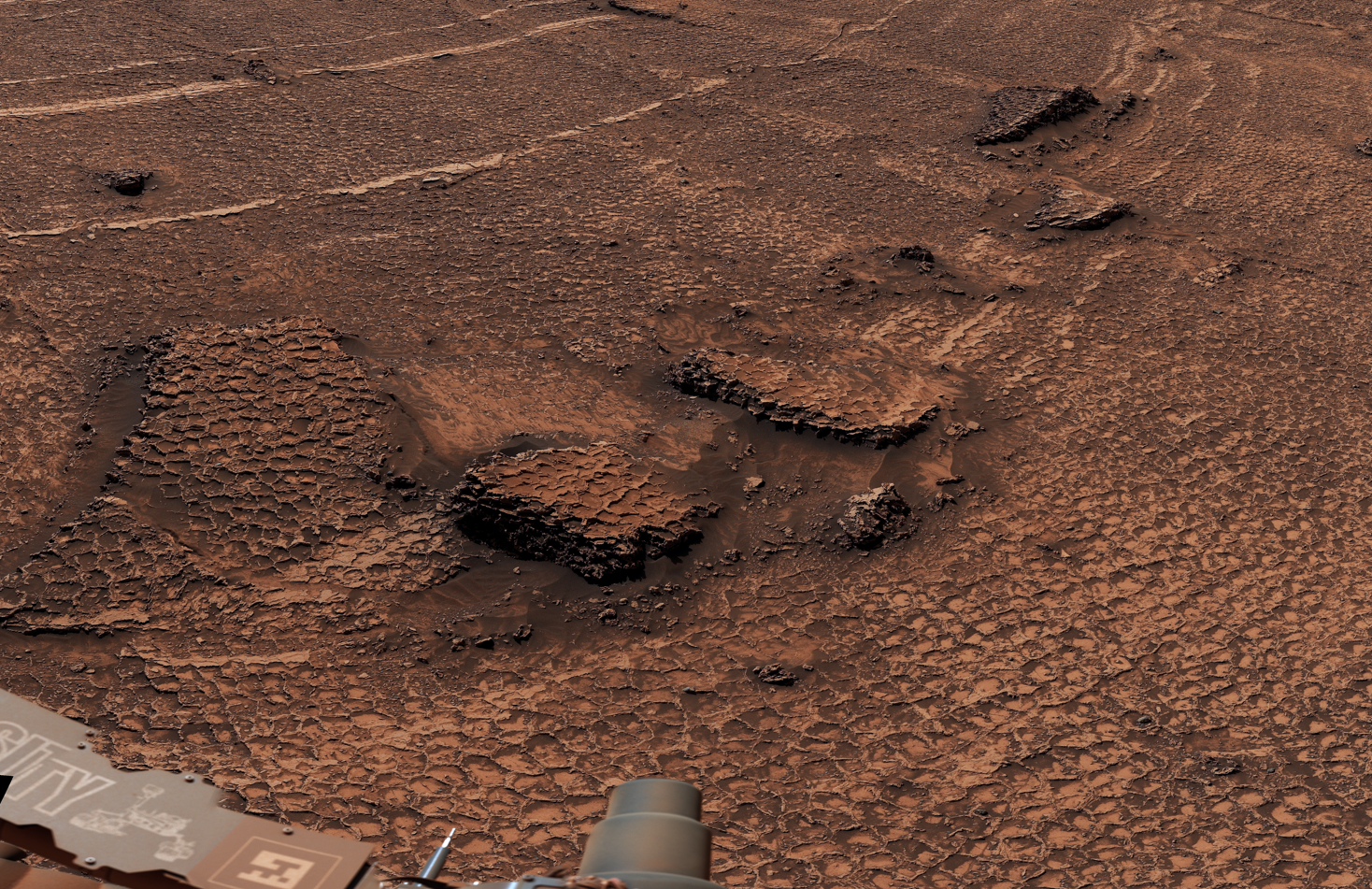
A close-up of the polygon fractures, each about 4 to 8 centimeters across. Credit: NASA/JPL-Caltech/MSSS
Curiosity has spotted small patches of this honeycomb texture before, scattered here and there over its fourteen years on Mars. It has just never found so much of it in one place. No bees were involved, for the record. Mars pulled off the honeycomb look using nothing but cracked mud, temperature swings, and roughly three billion years of patience.
Cracked Ground, Uncracked Mystery
According to Ashwin Vasavada, the mission’s project scientist at NASA’s Jet Propulsion Laboratory, the team has watched Curiosity cross plenty of memorable terrain over fourteen years, but this particular sea of polygons “took our breath away.” Researchers are now combing through the rover’s measurements of the shapes and their chemistry, hoping the data holds a clue to how they formed.
That “how” is the actual open question. Polygon cracks like these can form more than one way, and geologists haven’t settled on which process built Valle Grande. Mud that dried out and shrank can crack into hexagons, the same way a lakebed does back on Earth. Repeated freezing and thawing can do it too. So can compression, if the ground was buried and squeezed hard enough to wring water back out of the sediment. Any of the three could be the answer here, or some mix of all of them working on the same patch of ground at different points in Martian history.
Why a Field of Cracked Mud Actually Matters
Cracked ground doesn’t sound like headline material, but for a rover whose entire job is reconstructing Mars’s climate history, it’s exactly the kind of clue that counts. Curiosity has been climbing Mount Sharp, a five-kilometer mountain at the center of Gale Crater, since 2014, and the lower slopes it already crossed once held lakes and streams. The rover has previously turned up organic molecules that may be precursors to RNA and DNA, the two nucleic acids every living thing on Earth depends on. Nobody can say whether those molecules came from something alive or from ordinary chemistry, but their presence already proved Mars once had the right ingredients. A giant field of what might be ancient mud cracks fits neatly into that same story: water was here, and then, slowly, it wasn’t.
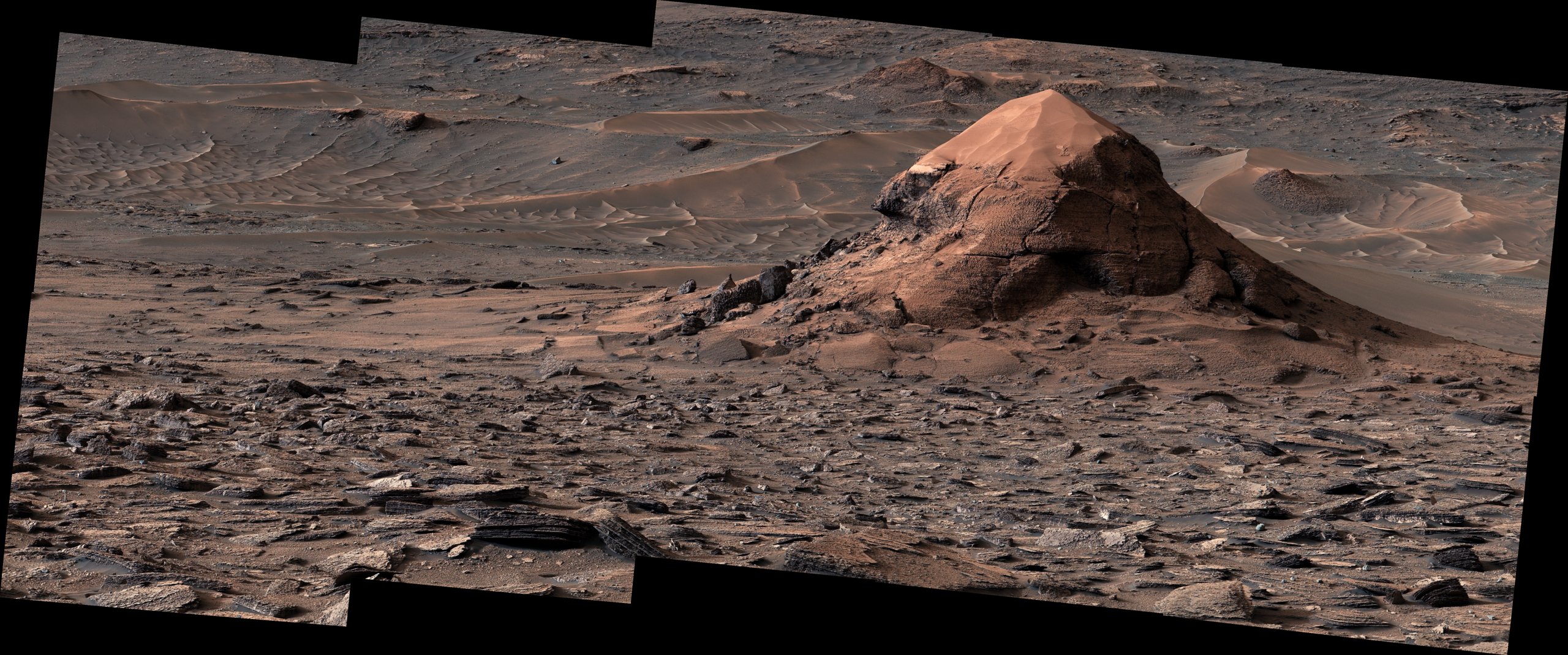
The sand-capped butte nicknamed “Miraflores,” about 20 feet tall, surrounded by the polygon field. Credit: NASA/JPL-Caltech/MSSS
Still Finding Surprises After Fourteen Years
Curiosity landed on Mars on August 5, 2012, which puts this discovery almost exactly on the mission’s anniversary. Most machines don’t get more interesting with age. This one just keeps turning up things nobody on Earth had seen before, on a planet where the weather report has read the same beige forecast for a few billion years running. Along the way it has also found sulfur crystals, a stray meteorite sitting out in the open, and a rock formation shaped enough like a flower that the internet had a field day with it.
There’s a nice, low-key kind of good news tucked into all of this. A robot the size of a golf cart, sent to a planet nobody lives on, is still finding new questions to ask after a decade and a half of driving over the same red dirt. If that’s not a reason to stay curious, it’s hard to say what is.
There once was a rover so bold,
Exploring the sights it beholds.
It found honeycomb stone,
Cracked mud, all alone,
A Martian mystery, ages old.
Sources: NASA / JPL · Phys.org
Discover more from Five Good Vibes
Subscribe to get the latest posts sent to your email.